Book

Art Galleries

Gift Shops

Publications

GIS Publications


Book

  • Minoan Bull Leaping Toreador Fresco Art
    Knossos, Crete, Greece

  • Minoan Miniature Frieze Admirals Flotilla Fresco Art
    in Three Panels
    Akrotiri, Santorini, Greece

  • Minoan Antelope Fresco Art
    Akrotiri, Santorini, Greece

  • Minoan Women "Ladies in Blue" Fresco Art
    Knossos, Crete, Greece

  • Minoan Dolphins Fresco Art
    Knossos, Crete, Greece

  • Minoan Octopus Fresco Art
    Knossos, Crete, Greece

  • Minoan Boxing Boys
    Fresco Art
    Akrotiri, Santorini, Greece

  • Minoan Priest King
    Feathered Prince of Lilies
    Fresco Art
    Knossos, Crete, Greece

  • Minoan Miniature Frieze Admirals Flotilla Fresco Art Shipping Scene
    Akrotiri, Santorini, Greece

  • Minoan Sea Daffodils 'Lilies' Fresco Art
    Akrotiri, Santorini, Greece

  • Minoan Miniature Frieze Admirals Flotilla Fresco Art Thera Scene
    Akrotiri, Santorini, Greece

  • Minoan Miniature Frieze Admirals Flotilla Fresco Art Ship Closeup
    Akrotiri, Santorini, Greece

  • Minoan Bull Leaping Toreador Fresco Art
    Knossos, Crete, Greece

  • Minoan Dolphins Fresco Art
    Knossos, Crete, Greece

  • Minoan Antelope Fresco Art
    Akrotiri, Santorini, Greece

  • Minoan Sea Daffodils Lilies Fresco Art
    Akrotiri, Santorini, Greece

  • Minoan Miniature Frieze Admirals Flotilla Fresco Art Thera Scene
    Akrotiri, Santorini, Greece

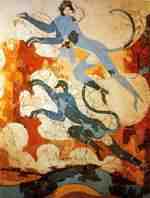
  • Minoan Blue Monkeys
    Fresco Art
    Akrotiri, Santorini, Greece

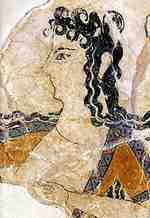
  • Minoan Dancer Fresco Art
    Knossos, Crete, Greece

  • Minoan Lady with Papyri Fresco Art
    Akrotiri, Santorini, Greece

  • Minoan Adorants Fresco Art Closeup
    Akrotiri, Santorini, Greece

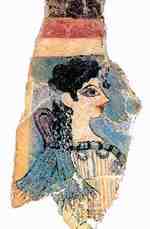
  • Minoan La Parisienne Fresco Art
    Knossos, Crete, Greece

  • Minoan Assembly on Hill Shipwreck Fresco Art
    Akrotiri, Santorini, Greece

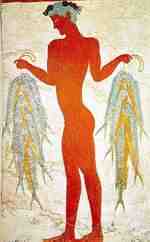
  • Minoan Fisherman
    Fresco Art
    Akrotiri, Santorini, Greece

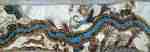
  • Minoan River Scene
    Fresco Art
    Akrotiri, Santorini, Greece

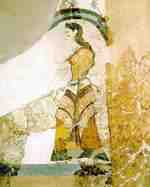
  • Minoan Saffron Gatherers Fresco Art
    Akrotiri, Santorini, Greece

  • Minoan Boxing Boys
    Fresco Art
    Akrotiri, Santorini, Greece

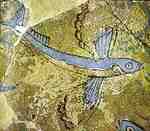
  • Minoan Flying Fish Fresco Art
    Phylakopi, Milos, Greece

  • Minoan Spring Fresco Art
    Akrotiri, Santorini, Greece

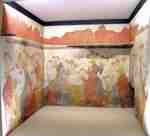
  • Minoan Fresco Art Exhibition
    Akrotiri, Santorini, Greece

  • Minoan Dolphins Fresco Art Scene
    Knossos, Crete, Greece

Minoan Fresco Fine Art Gallery

Imagekind - North America

This is our gallery of Bronze Age Aegean Fresco Art featuring original reproductions and precision restorations produced by Imagekind, a subsidiary of CafePress, based in the USA in Raleigh, North Carolina. Imagekind features an amazing selection of Museum-Quality Giclée Prints, Posters, Canvases, and Custom Framed Fine Art with over 5 Million Mat and Frame Combinations. All products are shipped World-Wide by FedEx with an Unconditional 30 Day Money Back Guarantee.

Artist: W. Sheppard Baird
minoanatlantis@gmail.com

Imagekind Imagekind Customer Service
care@imagekind.com
1.206.264.1446
1.800.351.8986 (USA only)

Fedex World-Wide Express Delivery


Minoan Miniature Frieze Admirals Flotilla Fresco Art
Shipping Scene

"Precision Restoration"
Late Bronze Age (LBA)
Late Minoan I (LM I) Period
Late Cycladic I (LC I) Period
Painted sometime before ~1615 BC
Akrotiri, Thera (Santorini), Greece

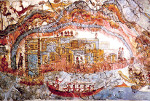
This is the second precision minimalist restoration of a scene from the Minoan Miniature Frieze Admirals Flotilla Fresco (see below) from Akrotiri. It depicts a large shipping scene from the center of the fresco. The work was derived from multiple original sources but especially from the superb publication "The Wall-Paintings of Thera" by Christos Doumas. The focus of this view is on a variety of ship types which clearly shows the Minoans were well versed in the different methods of propelling a ship across the sea including the use of the sail as the only means of power. The sailing ship's top mast indicates a (most probably) bronze eye-ring fixture that supports the sail. To me the most puzzling parts of this scene are the thin long poles(?) projecting from the stern turrets of some of the ships and the small figure on the right of the base of the stern turret of the sailing ship. Could the function of the figure be to somehow control the lines to the sail?

Other noteworthy aspects of the work center on the ship with 21 oars and prominent sun symbol on the side of it's hull in the top left. This vessel must have been very large. If you assume a tight 1.3 meters (4.3 feet) for the rowing space allotted to each oar, this results in 27.3 meters (89.6 feet) just for the assembly of oarsmen. This ship most probably well exceeded 35 meters (~115 feet) in length with a maximum beam width of something like 7 to 9 meters (23 to 29.5 feet). This is significantly larger than Columbus' largest ship on the first voyage - his flag ship the Santa Maria. It has been estimated at anywhere from 17.6 to 26.4 meters (57.7 to 86.6 feet) in length with a max. beam width of 5.9 to 7.9 meters (19.4 to 25.9 feet).

While it's highly decorated with sun-burst appearing floral ornaments, etc. for (probably) a celebration event related to the sun goddess, it has four boar's tusk helmets adorning it under the awning shading its passengers. It could have three more of these helmets on the ship's unrestored stern turret for a total of seven. As far as I can tell none of the other ships in the flotilla has more than one helmet. This very large ship must have been something like what we would refer to as the admiral's flag ship. Bronze Age boar's tusk helmets are symbols of war, conflict, and military power.

With the completion of this shipping scene about forty percent of the Miniature Frieze has now been fully restored using the precision minimalist methodology. This experience has given me a deep respect and admiration for the original artist's skill and technique. The Miniature Frieze is only 0.43 meters (~16.9 inches) high. To confine such an expansive scene in a relatively small format must have been a very great challenge indeed. The rendering of the detail is so fine that if only one artist was involved it must have taken many weeks to complete. With the obvious goal of telling the story of the event as comprehensively and accurately as possible I've come to believe the artist(s) had a strong sense of the achievement of excellence. This fresco would be a great masterpiece in art history if done by any artist in any time.

W. Sheppard Baird


Minoan Miniature Frieze Admirals Flotilla Fresco Art
in Three Panels

"Original Reproduction"
Late Bronze Age (LBA)
Late Minoan I (LM I) Period
Late Cycladic I (LC I) Period
Painted sometime before ~1615 BC
Akrotiri, Thera (Santorini), Greece

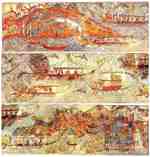
This exquisite fresco was found during the excavations conducted by Spyridon Marinatos from 1967 to 1974 at Akrotiri on the southern coast of the ringed islands of Santorini (the Pompeii of the Aegean) which was covered by thick deposits of ash and pumice from the great Bronze Age eruption of the Santorini marine volcano that occurred between 1627 and 1600 BC. It was discovered on the south wall of room 5 in the West House and is 3.90 meters (12.8 feet) wide and 0.43 meters (16.9 inches) high. This fabulous fresco is on display at the P. M. Nomikos Exhibition Center's Thera Wallpainting Exhibition Hall in the town of Fira which houses all of the restored frescoes found during the excavations at Akrotiri. It is considered the single most valuable source for information on the life and technology of the Bronze Age Aegean ever found.


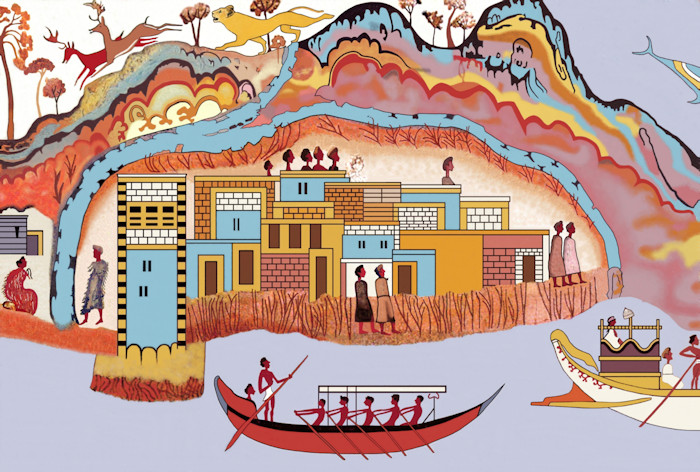
Minoan Miniature Frieze Admirals Flotilla Fresco Art
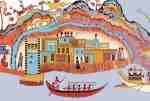
Ringed Islands of Thera Scene

"Precision Restoration"
Late Bronze Age (LBA)
Late Minoan I (LM I) Period
Late Cycladic I (LC I) Period
Painted sometime before ~1615 BC
Akrotiri, Thera (Santorini), Greece

This is the first precision restoration of a scene from the Miniature Frieze "Flotilla" Fresco. It depicts a detailed view of the ringed islands of Thera just before the great Bronze Age eruption of the Santorini marine volcano. It was derived from multiple original sources but especially from the superb publication "The Wall-Paintings of Thera" by Christos Doumas. While it represents a minimalist effort to accurately display the artist's original intention some areas of the fresco were so damaged that some degree of subjective interpretation was required to complete it. It clearly shows an inner island ringed by water in the middle of the caldera with a palace complex or town dominating the scene.


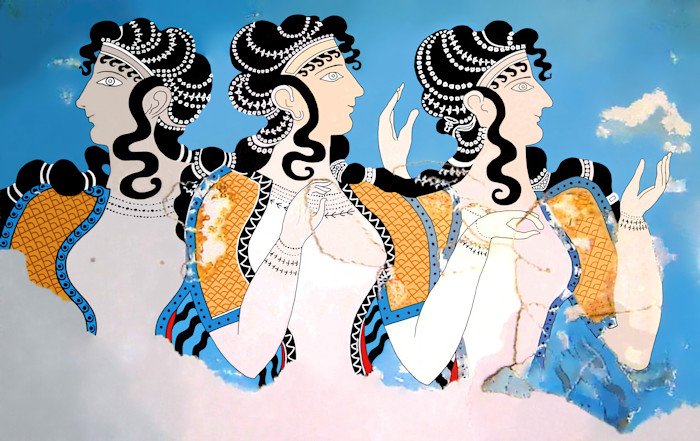
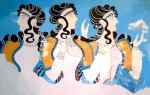
Minoan "Ladies in Blue" Women Fresco Art

"Original Reproduction"
Late Bronze Age (LBA)
Late Minoan (LM) Period
Knossos, Crete, Greece

Pieces of this fresco were found during Evan's excavation in the west wing of the Palace of Knossos and was later restored by Emile Gilliéron. His original restoration is in the Heraklion Archaeological Museum in Heraklion, Crete. The three white-skinned female figures with narrow waists and beautifully coiled hairstyles in this fresco are wearing form-fitting dresses with bare breasts. They are elaborately adorned with delicate necklaces, bracelets, and hair ornaments in a display of the great wealth of the Minoan court.


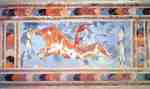
Minoan Bull Leaping Toreador Fresco Art

"Precision Restoration"
Late Bronze Age (LBA)
Late Minoan (LM) Period
Knossos, Crete, Greece

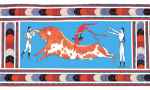
Fragments of this fresco (painted plaster) were discovered in the East Wing of the Palace of Knossos in the Courtyard of the Stone Spout during the excavations conducted by Arthur Evans between 1900 and 1904. The restored fresco is on display in Greece at the Heraklion Archaeological Museum in Heraklion, Crete. It is 78.2 cm (30.8 inches) high and 104.5 cm (41.1 inches) wide. It is dated from the Middle Minoan (MM) III through to the Late Minoan IB period or perhaps later. It depicts what is thought to be a male acrobat vaulting over the back of an agressive charging bull accompanied by two female attendants positioned at the front and back of the bull. The attendant in front of the bull has its left horn in her grasp and the one at the rear appears to be preparing to catch the leaper at the end of his vault.


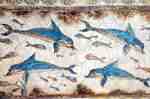
Minoan Dolphins Fresco Art

"Precision Restoration"
Late Bronze Age (LBA)
Late Minoan I (LM I) Period
Knossos, Crete, Greece

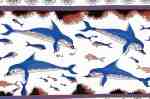
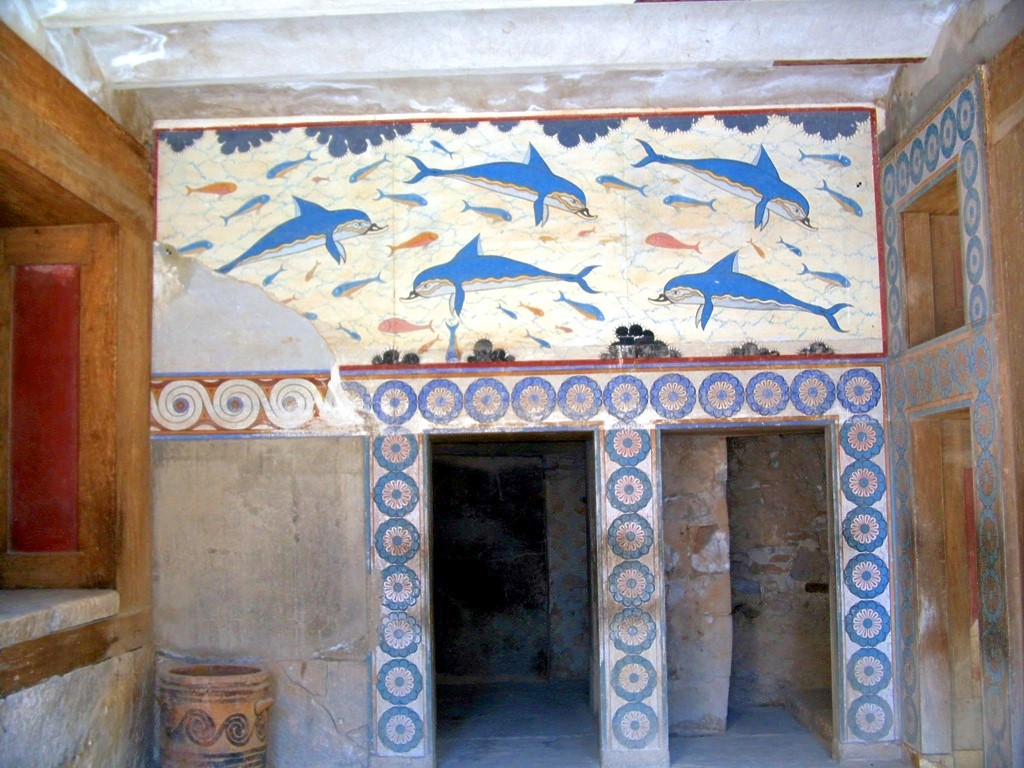
Pieces of this fresco were found in the East Wing's Residential Quarters of Knossos Palace in a room next to the Hall of the Double Axes which Arthur Evans named the Queen's Megaron. Other names associated with this section of the palace are the Queen's Apartment, the Queen's Hall, and the Dolphin Sanctuary. Evans thought of it as the Queen’s private reception room. Combining dolphins, fish and sea urchins it's one of Knossos’ most distinctive frescoes. It was restored by the artist Piet de Jong between 1922 and 1930. The original restoration is in the Heraklion Archaeological Museum in Heraklion, Crete. A replica of the fresco is displayed over the door on the north side of the room.


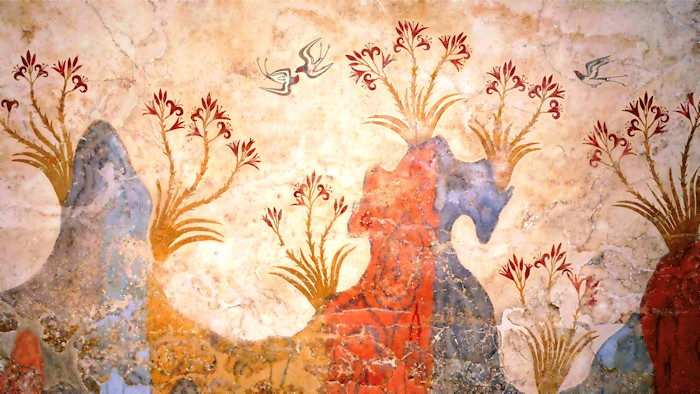
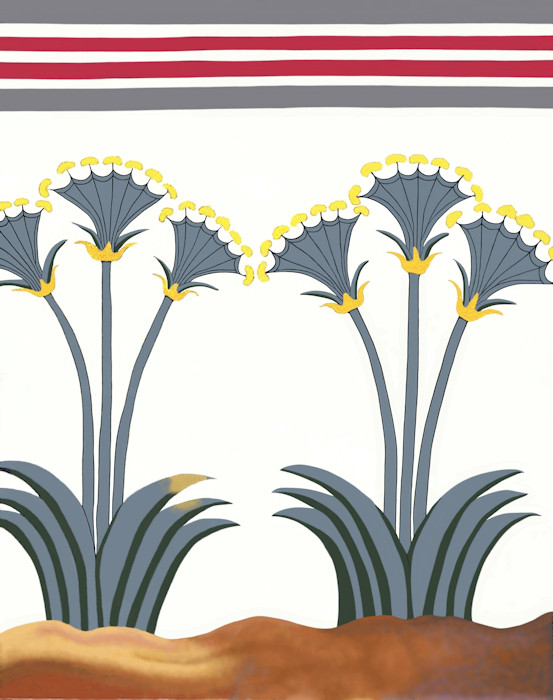
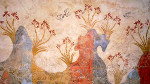
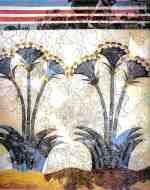
Minoan Sea Daffodils "Lilies" Fresco Art

"Precision Restoration"
Late Bronze Age (LBA)
Late Minoan I (LM I) Period
Late Cycladic I (LC I) Period
Painted sometime before ~1615 BC
Akrotiri, Thera (Santorini), Greece

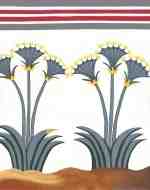
This fresco was found during the excavations conducted by Spyridon Marinatos from 1967 to 1974 at Akrotiri on the southern coast of the ringed islands of Santorini (the Pompeii of the Aegean) which was covered by thick deposits of ash and pumice from the great Bronze Age eruption of the Santorini volcano that occurred between 1627 and 1600 BC. It was discovered on the south wall of the west section of room 1 in the House of the Ladies and is 1.75 meters (5.7 feet) wide and 2.70 meters (8.9 feet) high. This exquisite fresco is on display at the P. M. Nomikos Exhibition Center's Thera Wallpainting Exhibition Hall in the town of Fira which houses all of the restored frescoes found during the excavations at Akrotiri.


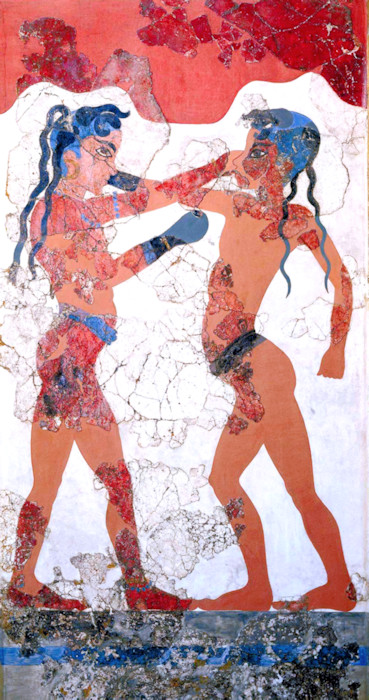
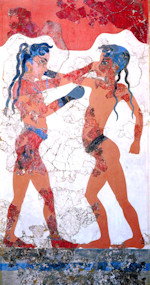
Minoan Boxing Boys Fresco Art

"Precision Restoration"
Late Bronze Age (LBA)
Late Minoan I (LM I) Period
Late Cycladic I (LC I) Period
Painted sometime before ~1615 BC
Akrotiri, Thera (Santorini), Greece

This fresco was found during the excavations conducted by Spyridon Marinatos from 1967 to 1974 at Akrotiri on the southern coast of the ringed islands of Santorini (the Pompeii of the Aegean) which was covered by thick deposits of ash and pumice from the great Bronze Age eruption of the Santorini volcano that occurred between 1627 and 1600 BC. It was discovered on the south wall of room 1 in the Beta Building and is 0.94 meters (3.1 feet) wide and 2.75 meters (9.0 feet) high. This exquisite fresco is on display at the P. M. Nomikos Exhibition Center's Thera Wallpainting Exhibition Hall in the town of Fira which houses all of the restored frescoes found during the excavations at Akrotiri.


Minoan Antelope Fresco Art

"Precision Restoration"
Late Bronze Age (LBA)
Late Minoan I (LM I) Period
Late Cycladic I (LC I) Period
Painted sometime before ~1615 BC
Akrotiri, Thera (Santorini), Greece

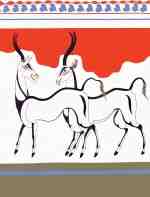
This fresco was found during the excavations conducted by Spyridon Marinatos from 1967 to 1974 at Akrotiri on the southern coast of the ringed islands of Santorini (the Pompeii of the Aegean) which was covered by thick deposits of ash and pumice from the great Bronze Age eruption of the Santorini volcano that occurred between 1627 and 1600 BC. It was discovered on the west wall of room 1 in the Beta Building and is 2.0 meters (6.6 feet) wide and 2.75 meters (9.0 feet) high. This exquisite fresco is on display at the P. M. Nomikos Exhibition Center's Thera Wallpainting Exhibition Hall in the town of Fira which houses all of the restored frescoes found during the excavations at Akrotiri.


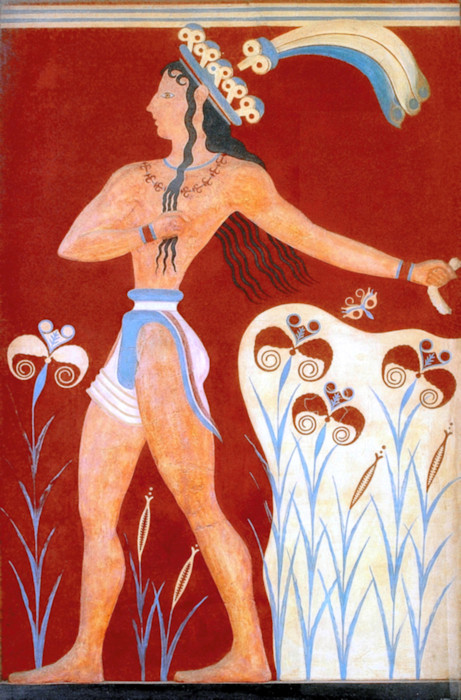
Minoan Priest King Feathered Prince of Lilies Fresco Art

"Original Reproduction"
Late Bronze Age (LBA)
Late Minoan (LM) Period
Knossos, Crete, Greece

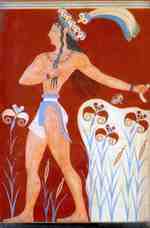
The first fragments of the "Feathered Prince" fresco were found during Evans' excavation near the south entrance to the central court of the palace at Knossos on May 11, 1901. It was restored by the artist Emile Gilliéron in 1905. The original restoration is in the Heraklion Archaeological Museum in Heraklion, Crete. A replica of the fresco is on display at Knossos near to where its fragments were found. The fresco's young male figure with broad shoulders and a narrow waist is dressed in a type of kilt similar to those worn in the "Bull Leaping" fresco and a crown of lilies and peacock feathers. He is also adorned with a necklace of golden lilies. The figure is thought to be leading a griffin or sphinx by the rope in his left hand through a field of lilies.


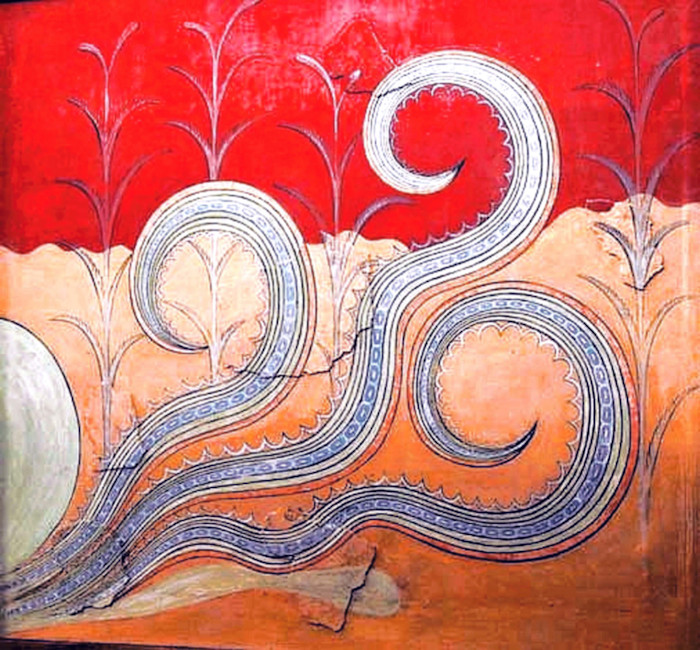
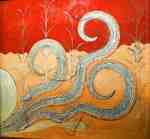
Minoan Octopus Fresco Art

"Original Reproduction"
Late Bronze Age (LBA)
Late Minoan (LM) Period
Knossos, Crete, Greece

A replica of this fresco is displayed in the "Loggia" (a light-well open to the air) directly above the Throne Room in the West Wing of Knossos palace. The original restoration is in the Heraklion Archaeological Museum in Heraklion, Crete. On the south side of the Throne Room is a room behind a balustrade with three wooden columns and a short flight of six steps leading down to a sunken floor. Arthur Evans called these sunken rooms "Lustral Basins". He assumed they were filled with water for use in ritual cleansing. But since his time this has fallen into question. Directly above the Lustral Basin was a light-well with an opening in the ceiling that probably extended to the roof of the palace. The floor above the basin where the Octopus fresco is displayed allowed for the observation of whatever occurred below to be viewed from overhead. During Evans' excavation several objects and pieces of crystal and gold were found in the basin that they believed had fallen from above.


Minoan Bull Leaping Toreador Fresco Art

"Original Reproduction"
Late Bronze Age (LBA)
Late Minoan (LM) Period
Knossos, Crete, Greece


Minoan Antelope Fresco Art

"Original Reproduction"
Late Bronze Age (LBA)
Late Minoan I (LM I) Period
Late Cycladic I (LC I) Period
Painted sometime before ~1615 BC
Akrotiri, Thera (Santorini), Greece


Minoan Dolphins Fresco Art

"Original Reproduction"
Late Bronze Age (LBA)
Late Minoan (LM) Period
Knossos, Crete, Greece


Minoan Sea Daffodils "Lilies" Fresco Art

"Original Reproduction"
Late Bronze Age (LBA)
Late Minoan I (LM I) Period
Late Cycladic I (LC I) Period
Painted sometime before ~1615 BC
Akrotiri, Thera (Santorini), Greece